

Zero Crossing Rate#
import IPython.display as ipd
import matplotlib.pyplot as plt
import librosa.display

from mirdotcom import mirdotcom

mirdotcom.init()
The zero crossing rate indicates the number of times that a signal crosses the horizontal axis.
Let’s load a signal:
filename = mirdotcom.get_audio("simple_loop.wav")
x, sr = librosa.load(filename)
Listen to the signal:
ipd.Audio(x, rate=sr)
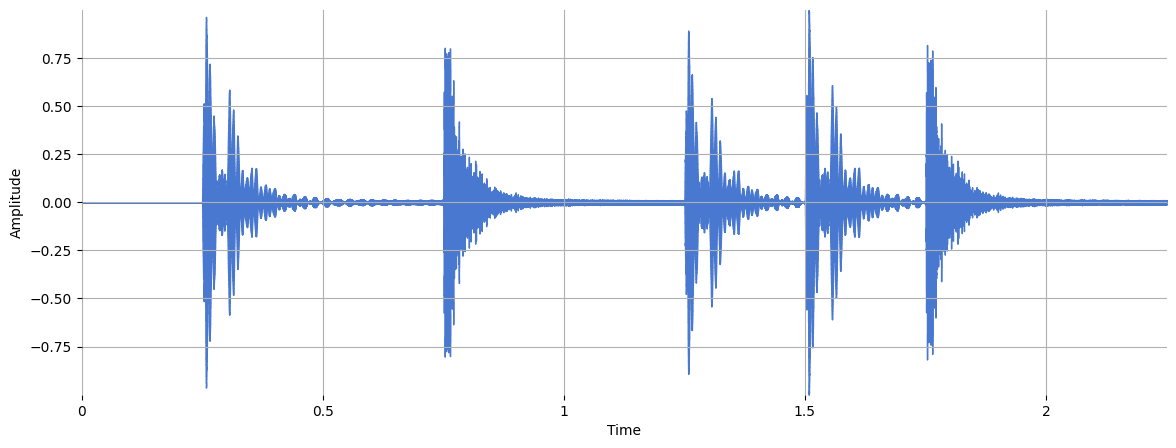
Plot the signal:
plt.figure(figsize=(14, 5))
librosa.display.waveshow(x, sr=sr)
plt.ylabel("Amplitude")
Text(117.47222222222221, 0.5, 'Amplitude')
Let’s zoom in:
n0 = 6500
n1 = 7500
plt.figure(figsize=(14, 5))
plt.plot(x[n0:n1])
plt.ylabel("Amplitude")
Text(0, 0.5, 'Amplitude')
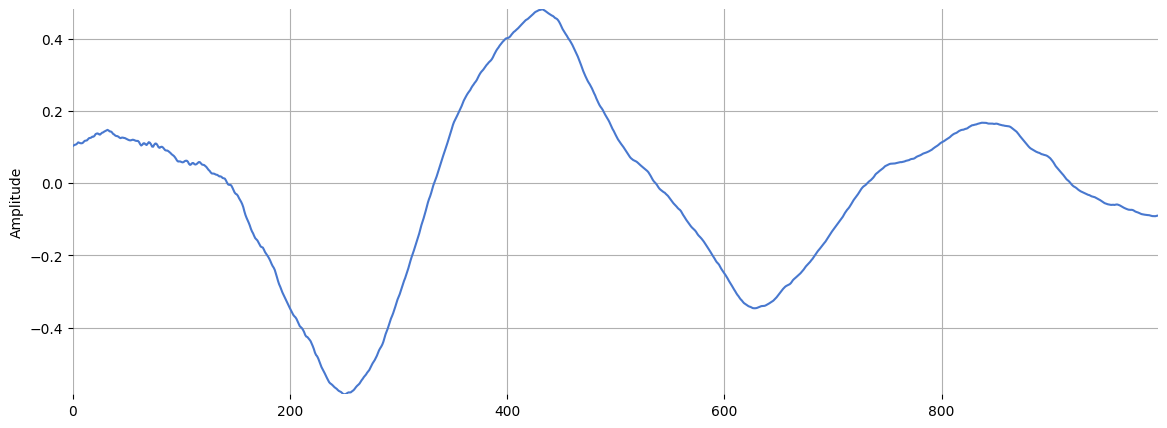
I count five zero crossings. Let’s compute the zero crossings using librosa.
zero_crossings = librosa.zero_crossings(x[n0:n1], pad=False)
zero_crossings.shape
(1000,)
That computed a binary mask where True indicates the presence of a zero crossing. To find the total number of zero crossings, use sum:
print(sum(zero_crossings))
5
To find the zero-crossing rate over time, use zero_crossing_rate:
zcrs = librosa.feature.zero_crossing_rate(x)
print(zcrs.shape)
(1, 97)
Plot the zero-crossing rate:
plt.figure(figsize=(14, 5))
plt.plot(zcrs[0])
plt.ylabel("Zero crossing rate")
Text(0, 0.5, 'Zero crossing rate')
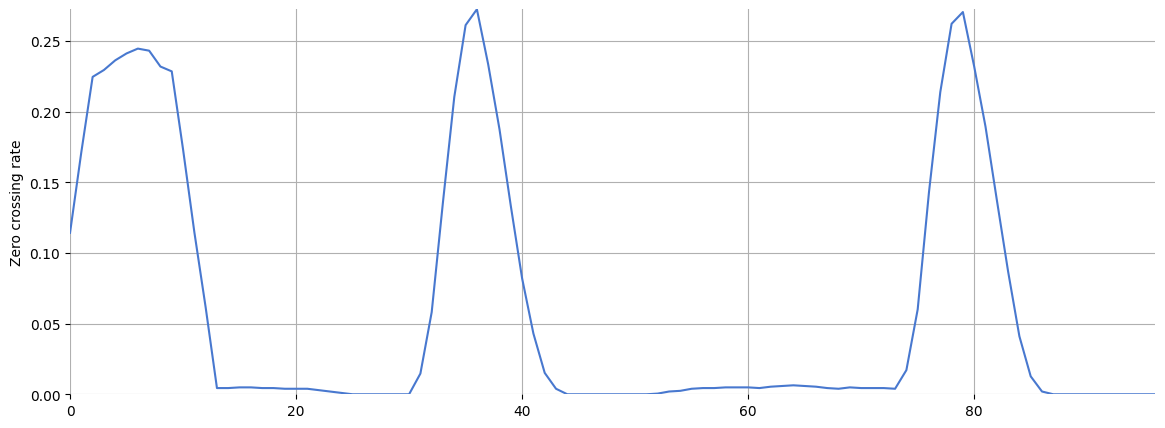
Note how the high zero-crossing rate corresponds to the presence of the snare drum.
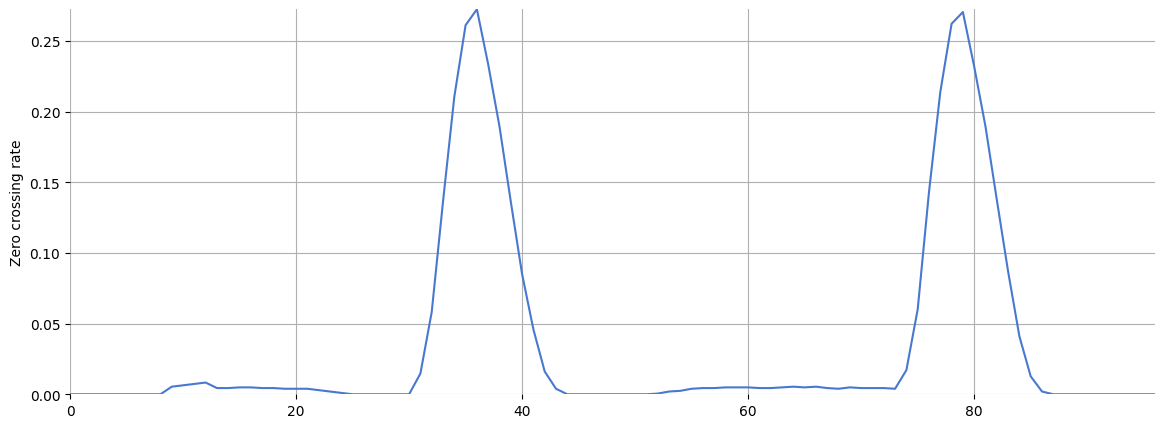
The reason for the high rate near the beginning is because the silence oscillates quietly around zero:
plt.figure(figsize=(14, 5))
plt.plot(x[:1000])
plt.ylim(-0.0001, 0.0001)
plt.ylabel("Amplitude")
Text(0, 0.5, 'Amplitude')

A simple hack around this is to add a small constant before computing the zero crossing rate:
zcrs = librosa.feature.zero_crossing_rate(x + 0.0001)
plt.figure(figsize=(14, 5))
plt.plot(zcrs[0])
plt.ylabel("Zero crossing rate")
Text(0, 0.5, 'Zero crossing rate')
Questions#
Try for other audio files. Does the zero-crossing rate still return something useful in polyphonic mixtures?
mirdotcom.list_audio()
simple_piano.wav
latin_groove.mp3
clarinet_c6.wav
cowbell.wav
classic_rock_beat.mp3
oboe_c6.wav
sir_duke_trumpet_fast.mp3
sir_duke_trumpet_slow.mp3
jangle_pop.mp3
125_bounce.wav
brahms_hungarian_dance_5.mp3
58bpm.wav
conga_groove.wav
funk_groove.mp3
tone_440.wav
sir_duke_piano_fast.mp3
thx_original.mp3
simple_loop.wav
classic_rock_beat.wav
c_strum.wav
prelude_cmaj.wav
sir_duke_piano_slow.mp3
busta_rhymes_hits_for_days.mp3