Pitch Transcription Exercise#
import IPython.display as ipd
import matplotlib.pyplot as plt
import librosa
import librosa.display
import numpy

from mirdotcom import mirdotcom

mirdotcom.init()
Load an audio file.
filename = mirdotcom.get_audio("simple_piano.wav")
x, sr = librosa.load(filename)
Play the audio file.
ipd.Audio(x, rate=sr)
Display the CQT of the signal.
bins_per_octave = 36
cqt = librosa.cqt(x, sr=sr, n_bins=300, bins_per_octave=bins_per_octave)
log_cqt = librosa.amplitude_to_db(cqt)
/tmp/ipykernel_22058/1787855213.py:3: UserWarning: amplitude_to_db was called on complex input so phase information will be discarded. To suppress this warning, call amplitude_to_db(np.abs(S)) instead.
  log_cqt = librosa.amplitude_to_db(cqt)
cqt.shape
(300, 166)
librosa.display.specshow(
    log_cqt, sr=sr, x_axis="time", y_axis="cqt_note", bins_per_octave=bins_per_octave
)
<matplotlib.collections.QuadMesh at 0x7d3a545225c0>
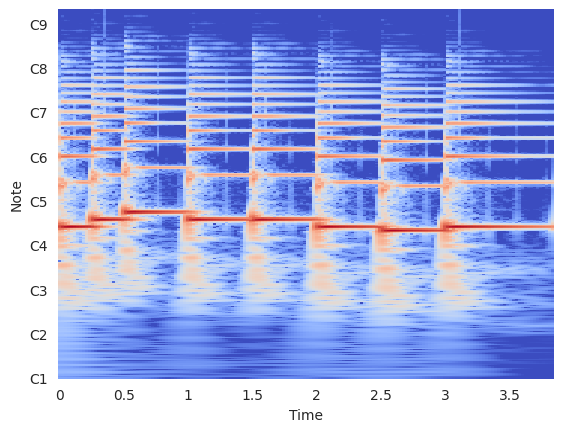
Goal: Identify the pitch of each note and replace each note with a pure tone of that pitch.
Step 1: Detect Onsets#
To accurately detect onsets, it may be helpful to see what the novelty function looks like:
hop_length = 100
onset_env = librosa.onset.onset_strength(y=x, sr=sr, hop_length=hop_length)
plt.plot(onset_env)
plt.xlim(0, len(onset_env))
plt.ylabel("Onset strength")
plt.xlabel("Time")
Text(0.5, 0, 'Time')
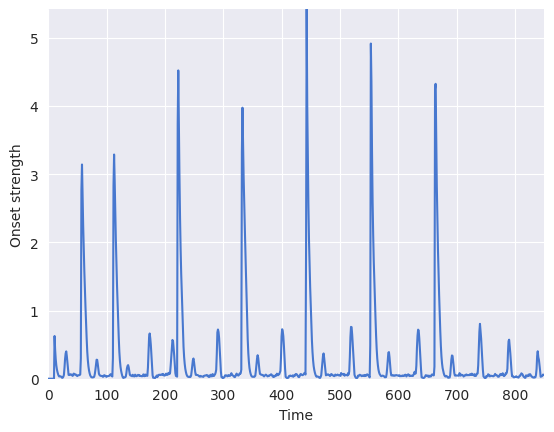
Among the obvious large peaks, there are many smaller peaks. We want to choose parameters which preserve the large peaks while ignoring the small peaks.
Next, we try to detect onsets. For more details, see librosa.onset.onset_detect and librosa.util.peak_pick.
onset_samples = librosa.onset.onset_detect(
    y=x,
    sr=sr,
    units="samples",
    hop_length=hop_length,
    backtrack=False,
    pre_max=20,
    post_max=20,
    pre_avg=100,
    post_avg=100,
    delta=0.2,
    wait=0,
)
onset_samples
array([ 5800, 11300, 22300, 33300, 44300, 55300, 66400])
Let’s pad the onsets with the beginning and end of the signal.
onset_boundaries = numpy.concatenate([[0], onset_samples, [len(x)]])
print(onset_boundaries)
[ 0 5800 11300 22300 33300 44300 55300 66400 84928]
Convert the onsets to units of seconds:
onset_times = librosa.samples_to_time(onset_boundaries, sr=sr)
onset_times
array([0.        , 0.26303855, 0.51247166, 1.01133787, 1.51020408,
       2.00907029, 2.50793651, 3.01133787, 3.85160998])
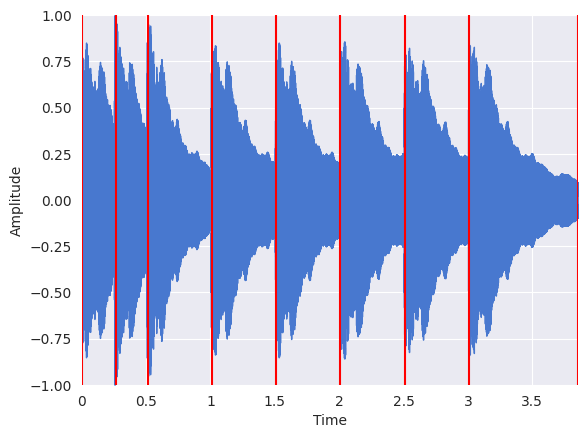
Display the results of the onset detection:
librosa.display.waveshow(x, sr=sr)
plt.vlines(onset_times, -1, 1, color="r")
plt.ylabel("Amplitude")
Text(22.472222222222214, 0.5, 'Amplitude')
Step 2: Estimate Pitch#
Estimate pitch using the autocorrelation method:
def estimate_pitch(segment, sr, fmin=50.0, fmax=2000.0):

    # Compute autocorrelation of input segment.
    r = librosa.autocorrelate(segment)

    # Define lower and upper limits for the autocorrelation argmax.
    i_min = sr / fmax
    i_max = sr / fmin
    r[: int(i_min)] = 0
    r[int(i_max) :] = 0

    # Find the location of the maximum autocorrelation.
    i = r.argmax()
    f0 = float(sr) / i
    return f0
Step 3: Generate Pure Tone#
Create a function to generate a pure tone at the specified frequency:
def generate_sine(f0, sr, n_duration):
    n = numpy.arange(n_duration)
    return 0.2 * numpy.sin(2 * numpy.pi * f0 * n / float(sr))
Step 4: Put it together#
Create a helper function for use in a list comprehension:
def estimate_pitch_and_generate_sine(x, onset_samples, i, sr):
    n0 = onset_samples[i]
    n1 = onset_samples[i + 1]
    f0 = estimate_pitch(x[n0:n1], sr)
    return generate_sine(f0, sr, n1 - n0)
Use a list comprehension to concatenate the synthesized segments:
y = numpy.concatenate(
    [
        estimate_pitch_and_generate_sine(x, onset_boundaries, i, sr=sr)
        for i in range(len(onset_boundaries) - 1)
    ]
)
Play the synthesized transcription.
ipd.Audio(y, rate=sr)
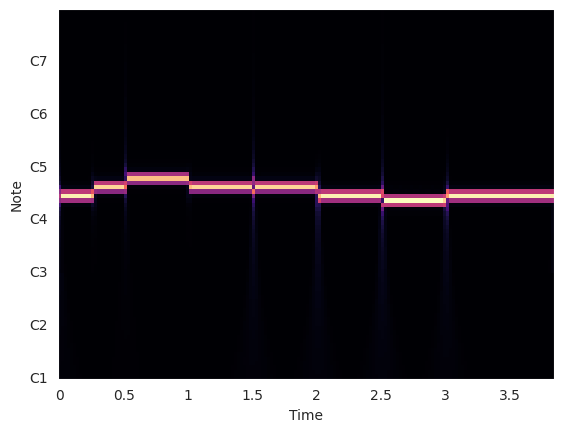
Plot the CQT of the synthesized transcription.
cqt = librosa.cqt(y, sr=sr)
librosa.display.specshow(abs(cqt), sr=sr, x_axis="time", y_axis="cqt_note")
<matplotlib.collections.QuadMesh at 0x7d3a508f5240>