

Harmonic-Percussive Source Separation#
import IPython.display as ipd
import matplotlib.pyplot as plt
import librosa.display

from mirdotcom import mirdotcom

mirdotcom.init()
Load two files: one harmonic, and one percussive.
filename = mirdotcom.get_audio("prelude_cmaj.wav")
xh, sr_h = librosa.load(filename, duration=7, sr=None)
ipd.Audio(xh, rate=sr_h)
filename = mirdotcom.get_audio("125_bounce.wav")
xp, sr_p = librosa.load(filename, duration=7, sr=None)
ipd.Audio(xp, rate=sr_p)
print(len(xh), len(xp))
154350 154350
print(sr_h, sr_p)
22050 22050
Add the two signals together, and rescale:
x = xh / xh.max() + xp / xp.max()
x = 0.5 * x / x.max()
x.max()
0.5
Listen to the combined audio signal:
ipd.Audio(x, rate=sr_h)
Compute the STFT:
X = librosa.stft(x)
Take the log-ampllitude for display purposes:
Xmag = librosa.amplitude_to_db(X)
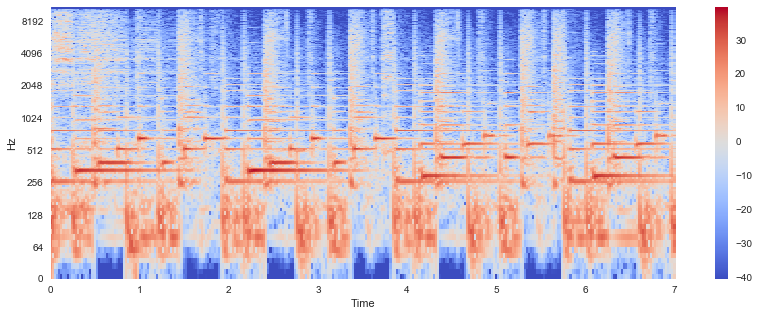
Display the log-magnitude spectrogram:
librosa.display.specshow(Xmag, sr=sr_h, x_axis="time", y_axis="log")
plt.colorbar()
<matplotlib.colorbar.Colorbar at 0x1139b14d0>
Perform harmonic-percussive source separation:
H, P = librosa.decompose.hpss(X)
Compute the log-amplitudes of the outputs:
Hmag = librosa.amplitude_to_db(H)
Pmag = librosa.amplitude_to_db(P)
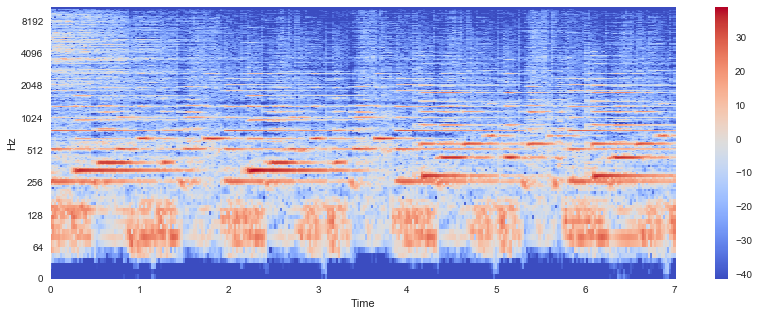
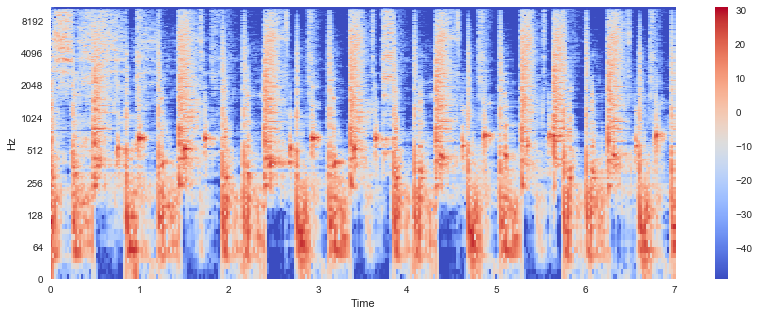
Display each output:
librosa.display.specshow(Hmag, sr=sr_h, x_axis="time", y_axis="log")
plt.colorbar()
<matplotlib.colorbar.Colorbar at 0x1139c2410>
librosa.display.specshow(Pmag, sr=sr_p, x_axis="time", y_axis="log")
plt.colorbar()
<matplotlib.colorbar.Colorbar at 0x1134df950>
Transform the harmonic output back to the time domain:
h = librosa.istft(H)
Listen to the harmonic output:
ipd.Audio(h, rate=sr_h)
Transform the percussive output back to the time domain:
p = librosa.istft(P)
Listen to the percussive output:
ipd.Audio(p, rate=sr_p)